


Building Products with Manufacturing in Mind
In India, product development moves quickly, but manufacturing challenges often move faster. A strong concept can lose momentum the moment it reaches production because the costing does not align, the material choice becomes impractical, or the manufacturing process is too complex to scale efficiently.
For businesses across consumer products, appliances, industrial systems, and home solutions, the real challenge often lies between design approval and manufacturing execution. A product may look right in the concept stage, but if it cannot be produced efficiently, serviced easily, or priced competitively, the market responds immediately. This is why product development must begin with manufacturing in mind, not treat it as a final stage.
Studios like Dhi-Tank work closely in this space, where product development is shaped not only by design intent, but by engineering decisions, production feasibility, and long term market readiness.
Cost Visibility Is a Product Decision
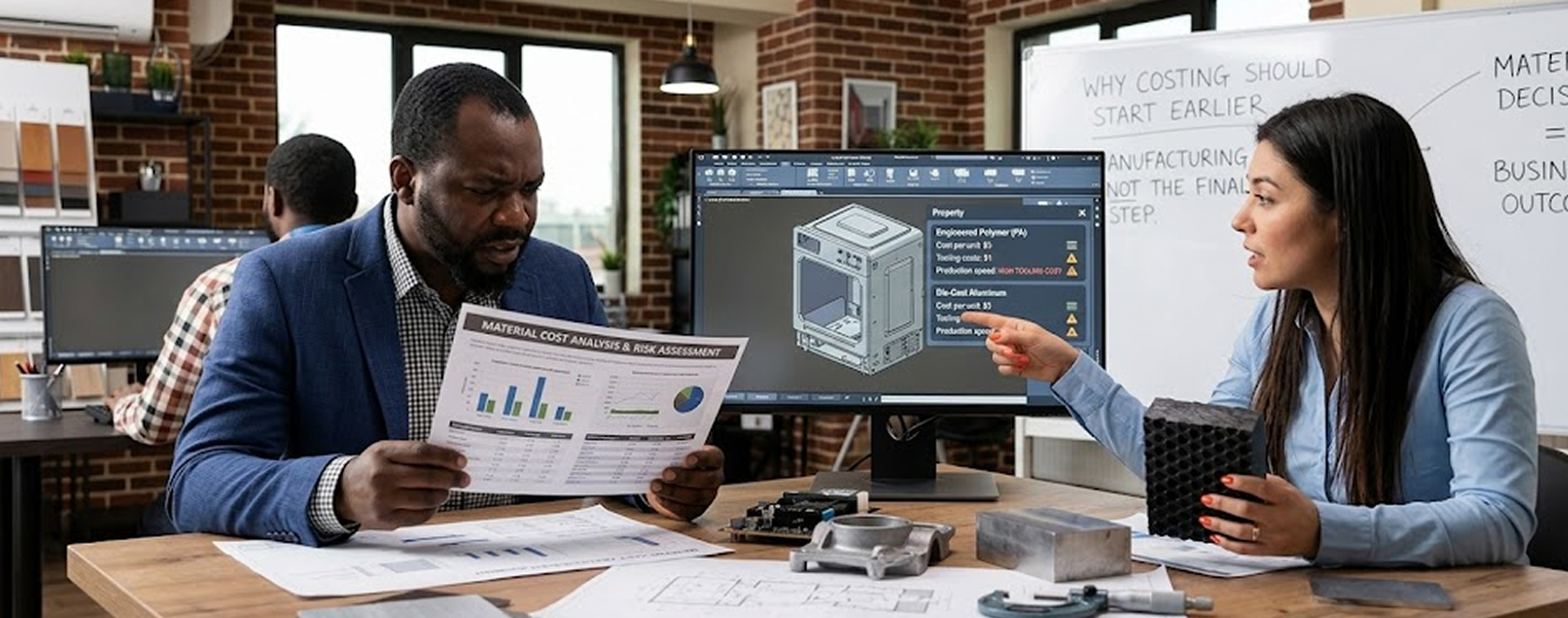
Costing is often treated as something to evaluate after the design is complete, but by that stage, most of the important decisions have already been made. Material selection, component design, assembly methods, and manufacturing processes directly affect the final cost of the product.
If these choices are made without cost visibility, businesses often face expensive redesigns later. This delays production, affects margins, and creates unnecessary pressure on launch timelines.
Early product costing creates clarity. It helps teams understand whether the product can be built within the expected price range while maintaining quality and functionality. It also helps founders and business heads make stronger commercial decisions before investing heavily in production.
A product should not only be possible to build. It should make commercial sense to build.
Material Selection Defines Product Performance
Material knowledge is one of the most important parts of engineering product development. It affects durability, aesthetics, maintenance, production cost, and long term performance.
Different products demand different priorities. A home appliance may require lightweight materials with a clean finish and efficient assembly, while an industrial product may need structural strength, thermal resistance, and higher durability under regular usage.
Processes such as sheet metal fabrication, plastic moulding, vacuum forming, CNC machining, and casting also influence how a product should be designed. A design that ignores these realities often becomes difficult to manufacture or too expensive to scale.
This is where engineering design services create real value. The right material decision is not just about appearance. It is about how the product performs during production and how it holds up in the market.
Manufacturing Support Is Part of Product Development
Manufacturing support is often misunderstood as the final step after design approval. In reality, it should be built into the development process from the start.
This includes vendor identification, mould design, jigs and fixtures, and production sample coordination. These are not operational details. They directly affect quality, speed, and production consistency.
Vendor identification is one of the most underestimated stages. The right manufacturing partner depends on capability, production capacity, and technical alignment with the product requirement. A poor vendor decision can lead to delays, inconsistent output, and avoidable cost increases.
Mould design plays an equally important role, especially for plastic parts where tooling decisions directly affect repeatability and production quality. Jigs and fixtures improve assembly precision, while production samples validate whether the design performs as expected before final manufacturing begins.
This is where structured manufacturing support becomes a competitive advantage.
End to End Product Development Reduces Business Risk
When costing, materials, and manufacturing are considered early, product development becomes stronger and far more predictable. Teams gain better cost control, faster approvals, and fewer production surprises.
End to end product development creates continuity between design intent and manufacturing execution. Instead of handing over a finished design and hoping production adapts, the product is developed with real manufacturing conditions in mind from day one.
For startups and growing businesses entering new categories, this becomes even more important. Early mistakes in engineering product development are expensive to reverse, while strong planning at the beginning creates smoother execution and better market readiness.
This is also where partners like Dhi-Tank add value, by bringing engineering clarity and manufacturing logic into the conversation much earlier in the process.
Products Built for the Real Market
A product is only successful when it works in the real market, not just in a prototype or presentation. It must be manufacturable, scalable, serviceable, and commercially viable.
This requires product engineering solutions that connect design with production, and engineering design services that solve practical problems before they become business problems.
In the Indian market, where pricing pressure, operational efficiency, and production speed matter deeply, building products with manufacturing in mind is not optional. It is the difference between a concept that stays in development and a product that reaches the customer with confidence.
The strongest products are rarely the most complicated. They are the ones built with clarity, where costing, materials, and manufacturing are treated as part of the design process from the very beginning.